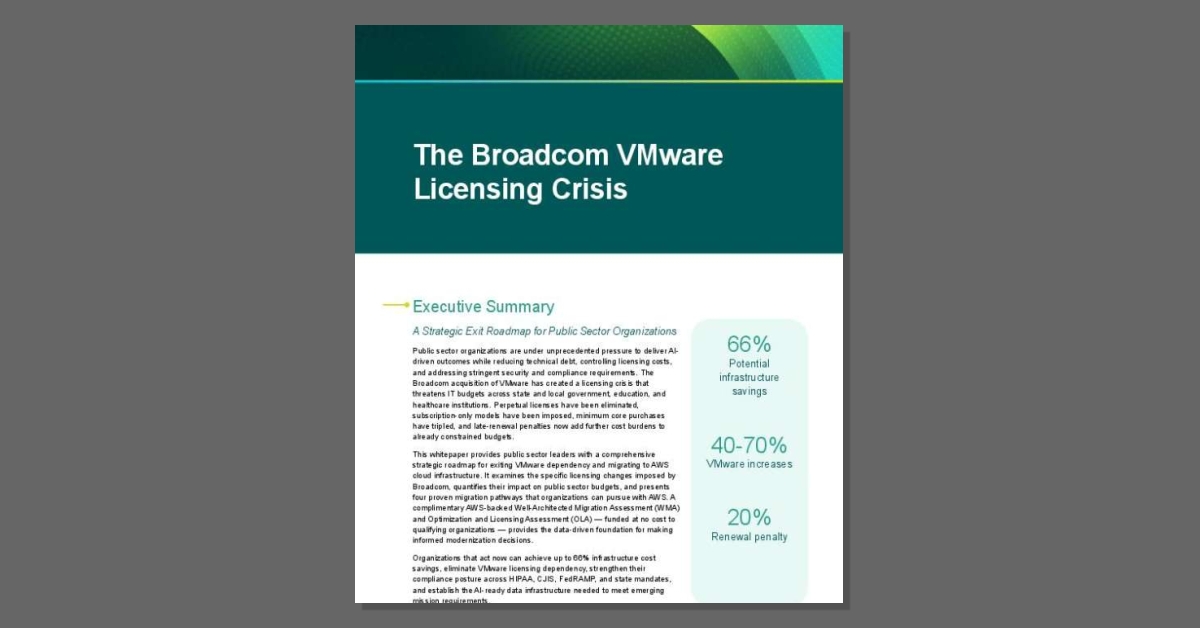
The AWS migration roadmap is designed to fit public sector realities—fixed budgets, long procurement cycles, and strict compliance—while providing a structured path away from VMware.
1. Assess (Weeks 1–6)
- Start with a complimentary AWS-backed Well-Architected Migration Assessment (WMA) and Optimization and Licensing Assessment (OLA), funded by AWS at no cost to qualifying organizations.
- Deliverables typically include:
- Full inventory of VMware workloads (VM counts, utilization, dependencies).
- Cost comparison of staying on VMware vs. migrating to AWS across all four pathways.
- License-efficiency matrix (BYOL vs. license-included recommendations).
- Readiness scorecard aligned to the AWS Well-Architected Framework.
- Compliance gap analysis (which AWS regions/services meet your regulatory needs).
- Target architecture and migration wave plan.
2. Mobilize (Weeks 6–12)
- Build the AWS landing zone (accounts, networking, IAM, logging, security baselines).
- Implement controls aligned to FedRAMP, CJIS, HIPAA, and state mandates.
- Set up connectivity (AWS Direct Connect or VPN) to on-premises data centers.
- Provision initial AWS services based on assessment findings.
- Run a pilot migration of a low-risk workload to validate the approach.
- Finalize the wave plan with timelines, resources, and risk mitigation.
3. Migrate (Weeks 12–36)
- Execute wave-based migrations, prioritizing workloads with the highest VMware licensing burden and the clearest migration path.
- Use one or more of the four AWS migration pathways:
- Path 1 – Amazon Elastic VMware Service (Amazon EVS): Fastest way to run VMware Cloud Foundation in your own Amazon VPC. Good for rapid moves (e.g., data center closures) while preserving VMware tools and skills. Requires bring-your-own VCF subscription initially.
- Path 2 – EC2 Rehost (Application Migration Service): Lift-and-shift VMware VMs to Amazon EC2 with near-zero downtime. Ideal for eliminating VMware licensing and moving to pure EC2, with 40–60% compute and 45–77% license savings often identified in OLA.
- Path 3 – AWS Native Services: Refactor into containers (ECS/EKS), managed databases (RDS/Aurora), file services (FSx), and virtual desktops (WorkSpaces). This is the deepest modernization path, often delivering 50–70% compute savings for container-ready workloads and ~30% storage savings.
- Path 4 – Enhanced Integration (AWS Transform): Use AI-driven orchestration to mix rehost and replatform in one project. Automatically translate network/security policies and migrate storage to services like Amazon FSx for NetApp ONTAP. Typical savings: 50–70% for container-ready workloads plus 45–77% license reduction.
- Each wave includes testing, cut-over with rollback options, performance validation, and decommissioning of on-premises infrastructure and VMware licenses.
4. Optimize (Ongoing)
- Apply Savings Plans and reserved capacity recommendations from the OLA.
- Right-size instances based on real utilization.
- Retire unused licenses and subscriptions.
- Expand use of AWS native services for additional savings and automation.
- Use AWS Budgets and Cost Explorer for ongoing cost governance.
- Build AI-ready data infrastructure using AWS analytics and machine learning services.
How funding programs fit in
- OLA (Optimization and Licensing Assessment): Fully funded by AWS; recommended starting point.
- Migration Acceleration Program (MAP): Partner cash incentives—up to 5% ARR for assessment (max $75K) and up to 20% ARR for mobilization (max $2M).
- VMware Modernization Program (VMP): Migrate-and-modernize service credits up to 25% ARR, reducing ongoing AWS costs.
- AWS Modernization Assurance (AMA): For larger deals (>$2M ARR), provides up to 25–30% of post-modernization ARR in partner cash, capped at $1M.
- AWS-funded ISV tools: Up to $200K for assessment tools and up to $2M per customer for migration and modernization tooling.
To get started, public sector organizations typically request the complimentary WMA/OLA, review their current VMware licensing and renewal dates, identify quick-win workloads, engage procurement and compliance stakeholders early, and use the migration as a chance to reimagine their AI and data strategy on AWS.



 Sign in with LinkedIn